

About the program
The Rhode Island Office of Energy Resources (OER) ChargeRI Program provides financial incentives for the purchase and installation of energy-efficient, ENERGY STAR-certified electric vehicle supply equipment (EVSE) at eligible sites across Rhode Island. This program seeks to make EV charging infrastructure more accessible to Rhode Island residents, renters, businesses, landlords, municipalities, nonprofits, and communities — by reducing the upfront cost barriers to installation. ChargeRI provides incentives across four eligible project sectors: Multi-Unit Dwellings (MUDs), Publicly Accessible Commercial Sites, Municipalities & Educational Campuses, and Workplaces. Nonprofit organizations are eligible to apply under any of these sectors, provided the proposed project meets the applicable sector requirements.
Rebate amounts and eligibility requirements vary by sector and charging type. Applicants should review the applicable sector requirements and current funding availability before submitting an application.
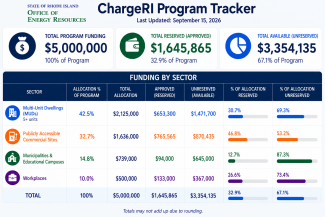
Current funding availability by sector is provided in the ChargeRI Program Tracker below.
How it works
Program overview
Before applying, review the key eligibility requirements and program conditions below. For complete details, download the Program Guidance Document.
ChargeRI is open to property owners, businesses, municipalities, educational institutions, and authorized representatives across four eligible sectors:
- Multi-Unit Dwellings (MUDs) — Priority sector: Owners, landlords, property managers, or authorized HOA representatives of residential buildings with 5 or more units, including properties serving renters.
- Publicly Accessible Commercial Sites: Gas stations, restaurants, retail centers, hotels, parking lots and garages, and similar sites open to the general public.
- Municipalities & Educational Campuses: Rhode Island city and town governments, public school districts, and public colleges and universities.
- Workplaces: Private employers installing Level 2 EVSE for employee use or fleet charging.
Nonprofit organizations with active 501(c)(3) status, registered to operate in Rhode Island, are eligible to apply under any sector.
A representative installer or company may apply on behalf of an eligible entity with written authorization submitted through the portal.
- All project sites must be located within Rhode Island.
- All EVSE equipment must be energy-efficient, ENERGY STAR-certified. Level 1 (120V) equipment does not qualify.
- Equipment must be newly purchased and installed. No retroactive rebates for prior purchases.
- Do not purchase equipment or begin installation until you have received your OER Approval Letter.
- A minimum 3-year network/cloud service agreement is required for all installed stations.
- At least one ADA-accessible parking space must be designated at each installation site.
- Appropriate on-site EV charging signage must be installed and parking spaces must be clearly marked/striped to designate EV charging areas.
- Projects must be completed within 6 months of the OER Approval Letter date.
- The estimated project start date must be within 3 months of your application submission date. Do not apply if your project is not ready to begin in the near future.
- Sites that have received or been awarded funding under the NEVI program are not eligible for ChargeRI.
- One application per site address. Multiple applications for the same physical address are not permitted.
- Each site must be at a distinct zip code address. An entity applying for multiple sites must use a different zip code for each.
- No single entity may hold more than three (3) active rebate reservations at any given time. Once a project is completed, inspected, and paid out, the entity may submit a new application.
- OER reserves the right to limit approvals within any single zip code area to ensure equitable geographic distribution of funds across Rhode Island.
Program Documents
Step 1 — New applicants
Reserve your funds
Submit your initial application to reserve your place in the funding queue. Complete this step before purchasing or installing any equipment.
Step 2 — Returning applicants
Submit for payment
Return here after OER confirms your site inspection is approved. You will need your reservation ID from your approval letter to access this portal.
Rebate amounts
Standard rates apply to all eligible projects. EJ (Environmental Justice) rates apply to projects in RI state-designated EJ communities — the +5% adder increases the cost coverage rate, per-station cap, and per-site cap simultaneously.
Multi-Unit Dwellings (MUDs) — Priority sector
Apartments, condos, mixed-use residential with 5+ units
| EVSE type | Standard | EJ community (+5%) | ||||
|---|---|---|---|---|---|---|
| Cap % | Per station | Per site | Cap % | Per station | Per site | |
| Level 2 | 90% | $12,000 | $100,000 | 95% | $12,600 | $105,000 |
Publicly Accessible Commercial Sites
Gas stations, restaurants, retail, hotels, parking — open to any driver
| EVSE type | Standard | EJ community (+5%) | ||||
|---|---|---|---|---|---|---|
| Cap % | Per station | Per site | Cap % | Per station | Per site | |
| Level 2 | 80% | $10,000 | $60,000 | 85% | $10,500 | $63,000 |
| DCFC | 80% | $50,000 | $100,000 | 85% | $52,500 | $105,000 |
Municipalities & Educational Campuses
City/town government, public schools, colleges
| EVSE type | Standard | EJ community (+5%) | ||||
|---|---|---|---|---|---|---|
| Cap % | Per station | Per site | Cap % | Per station | Per site | |
| Level 2 | 80% | $10,000 | $80,000 | 85% | $10,500 | $84,000 |
| DCFC | 80% | $50,000 | $100,000 | 85% | $52,500 | $105,000 |
Workplaces
Private employers, employee parking, fleet charging
| EVSE type | Standard | EJ community (+5%) | ||||
|---|---|---|---|---|---|---|
| Cap % | Per station | Per site | Cap % | Per station | Per site | |
| Level 2 | 80% | $10,000 | $60,000 | 85% | $10,500 | $63,000 |
Please note:
Nonprofit organizations are eligible to apply under any of the sectors listed above, provided the proposed project meets the applicable sector requirements.
For eligible projects proposing both Level 2 and DC Fast Charging (DCFC) stations, incentives will be calculated separately for each charging type using the applicable per-station and per-site maximums. The Level 2 and DCFC incentive amounts will then be combined to determine the maximum potential project rebate, subject to the applicable cost coverage percentage, Environmental Justice (EJ) incentive where applicable, eligible project costs, and all other program requirements.
Frequently asked questions
Eligible applicants include owners or authorized representatives of the following entity types. All project sites must be located within Rhode Island.
- Multi-Unit Dwellings (MUDs): Owners, landlords, property managers, or authorized HOA representatives of residential buildings with 5 or more units, including properties serving renters. A representative installer may also apply on behalf of the entity with written authorization.
- Publicly accessible commercial sites: Gas stations, convenience stores, restaurants, retail centers, hotels, parking lots and garages, and similar destinations open to the general public.
- Municipalities & educational campuses: Rhode Island city and town governments, public school districts, public colleges and universities.
- Workplaces: Private employers installing Level 2 EVSE for employee use or fleet charging.
Nonprofit organizations with active 501(c)(3) status, registered to operate in Rhode Island, are eligible to apply under any sector.
All EVSE equipment must be Energy Star-certified. Level 2 (240V) and DC Fast Charging (DCFC) equipment are eligible. Level 1 (120V) equipment does not qualify and has no Energy Star certification category.
A current list of certified equipment is available on the U.S. EPA Energy Star website.
For projects proposing a single EVSE type, the rebate is calculated using the applicable cost coverage percentage, per-station maximum, and per-site maximum for the project sector.
For eligible projects that include both Level 2 and DCFC stations, OER will calculate the Level 2 and DCFC portions separately using the applicable per-station and per-site maximums for each charging type. The two amounts will then be combined to determine the maximum potential project rebate.
In all cases, the final rebate cannot exceed the applicable percentage of eligible project costs and is subject to all ChargeRI program requirements.
Example scenarios for a MUD project:
- Project cost $30,000 — at 90% coverage = $27,000. Under site cap. Rebate = $27,000.
- Project cost $90,000 — at 90% coverage = $81,000. Under site cap. Rebate = $81,000.
- Project cost $150,000 — at 90% coverage = $135,000. Exceeds site cap. Rebate = $100,000.
Yes. Eligible Publicly Accessible Commercial Sites and Municipalities & Educational Campuses may include a combination of Level 2 and DCFC stations.
For projects that include both charging types, OER will calculate the Level 2 and DCFC portions separately using the applicable per-station and per-site maximums and then combine the two amounts to determine the maximum potential project rebate.
Example: A Publicly Accessible Commercial Site proposing six Level 2 stations and two DCFC stations could qualify for up to $60,000 for the Level 2 portion and up to $100,000 for the DCFC portion, for a combined maximum potential rebate of $160,000.
If the same project is located within an eligible Environmental Justice (EJ) community, the enhanced maximums would be $63,000 for the Level 2 portion and $105,000 for the DCFC portion, for a combined maximum potential rebate of $168,000.
The actual rebate may be lower depending on eligible project costs and the applicable cost coverage percentage.
The following costs are eligible for inclusion in the rebate calculation:
- EVSE station equipment purchases
- EVSE installation costs and labor
- Power connection and make-ready work
- Electrical supply upgrade (for EVSE operation only)
- Permitting and design fees
- Cable management, mounting equipment, protective devices (e.g. bollards)
- Striping and on-site signage
- ADA-accessible space preparation
- Warranty coverage (first 3-year period)
- Networking/cloud service plan (first 3-year period — required)
- Shipping and freight
For a full list of allowable and non-allowable costs, please refer to Section 4 of the Program Guidance Document.
Projects located in Rhode Island state-designated Environmental Justice (EJ) communities qualify for an additional +5% above the standard rates. The adder applies to all three parameters simultaneously:
- The cost coverage percentage increases by 5 percentage points (e.g., 80% → 85%; 90% → 95%)
- The per-station dollar cap increases by 5% (e.g., $10,000 → $10,500; $12,000 → $12,600)
- The per-site dollar cap increases by 5% (e.g., $60,000 → $63,000; $100,000 → $105,000)
Use the RIDEM Environmental Justice Area mapping tool to check if your project site qualifies by entering the site address. OER will verify EJ status at the time of application review.
For eligible projects that include both Level 2 and DCFC stations, the applicable EJ-enhanced rates and maximums will be applied separately to each charging type before determining the combined maximum potential project rebate.
Yes, but with limits. A single company or entity may hold no more than three (3) active rebate reservations at any given time. Each application must be for a site at a distinct zip code address, and each must be submitted separately through Portal 1. Multiple applications for the same physical street address are not permitted.
Once a project has been completed, inspected, and paid out, the entity may submit a new application, provided funding remains available.
Yes. Nonprofit organizations with active 501(c)(3) status, registered to operate in Rhode Island, are eligible to apply under any sector. This includes nonprofits operating multi-unit housing, publicly accessible sites, educational facilities, or workplaces.
To ensure equitable geographic distribution of funds across Rhode Island, OER reserves the right to limit the number of approved applications within any single zip code area. If an unusually high volume of applications is received for the same zip code, OER may approve applications in the order they were received and place remaining applications on hold.
Applicants placed on hold will be notified and may be approved as funding and geographic balance allow. This determination is at OER’s sole discretion.
No. Projects located at sites that have received or been awarded funding under the NEVI program are not eligible for a ChargeRI rebate.
However, applicants who have NEVI-funded sites may still apply for ChargeRI at different, non-NEVI-funded locations, subject to all other program requirements.
Costs incurred prior to receiving your OER Approval Letter are not eligible for reimbursement. This includes equipment purchased, installation work performed, or any construction started before the approval date.
Do not purchase equipment or begin any installation work until you have received your official Approval Letter from OER. Your reservation ID and approved rebate amount will be confirmed in that letter.
You should reserve funds when your project is ready to move forward in the near future. The ChargeRI program requires that your estimated project start date be within 3 months of the date you submit your application. Applications for projects with a start date beyond 3 months will not be approved.
If your project is still in early planning stages or is not anticipated to begin within the next 3 months, we encourage you to wait to apply until you are closer to your start date. Funding is awarded on a first-come, first-served basis and is subject to availability at the time of application.
Once you receive your Approval Letter, your project must be fully installed and operational within 6 months of the approval date.
Projects must be fully installed and operational within 6 months of the date on the OER Approval Letter.
Extensions may be granted due to weather delays or unforeseen conditions. A written email request must be submitted to OER prior to the expiration of the 6-month period. OER reserves the right to approve or deny extension requests.
Projects not completed within the approved timeframe will forfeit their reservation and funds will be released back to the sector allocation.
ChargeRI is a post-installation reimbursement program. OER does not issue any upfront payments.
After your site inspection is approved by OER, return to Portal 2 using your reservation ID to submit your final documentation. Payment is made as a one-time check once all documents are verified and found to be in order.
All projects funded through ChargeRI must include at least one (1) accessible EV charging space in compliance with applicable federal, state, and local accessibility requirements.
Key considerations include ensuring adequate space for exiting and entering the vehicle, unobstructed access to the EVSE, free movement around the charging station and connection point, and clear paths to any building entrances.
For full accessibility specifications, please refer to the ChargeRI Accessibility Guidance Document.
Yes. All ChargeRI-funded installations must include appropriate on-site signage and parking space markings to clearly designate EV charging spaces.
Signage:
- Vertical or pole-mounted signage must be installed at or near each EV charging space, clearly identifying it as an EV charging-only space.
- Signage should include a visual EV symbol and/or text such as “Electric Vehicle Charging Only”, or both.
- Wayfinding signage directing drivers to the charging station location is strongly encouraged.
Parking space markings:
- Pavement markings must be applied to designated EV charging spaces, similar to those used for accessible parking spaces.
- Ground markings should clearly delineate the EV charging space and any required access aisles.
- For ADA-accessible EV charging spaces, pavement markings must also indicate accessible routes that must remain clear.
Signage and pavement marking costs are allowable project costs under the ChargeRI program.
By submitting an application, the applicant agrees to the following:
- All information provided is accurate and complete. Misrepresentation may result in disqualification and recovery of funds.
- This is a post-installation reimbursement program. No payment is guaranteed until inspection approval and document verification.
- Installed EVSE and the 3-year network service plan must be maintained for a minimum of 3 years from the operational date.
- OER reserves the right to audit project costs and conduct site inspections at any time.
- OER’s decisions regarding eligibility and rebate amounts are final.
- Reserved funds not claimed within the approved timeline will be forfeited and returned to the sector allocation.
- Rebate reservations are non-transferable without prior written approval from OER.
- Each entity is limited to no more than three (3) active rebate reservations at any given time, each at a distinct zip code address. OER reserves the right to limit approvals within any single zip code area to ensure equitable geographic distribution of funds.
- OER reserves the right to modify, suspend, or terminate the program at any time.
For full terms and conditions, see Section 7 of the Program Guidance Document.
Contact
Sara Canabarro
Program Administrator — ChargeRI
(401) 574-9100
Rhode Island Office of Energy Resources
One Capitol Hill, Providence, RI 02908